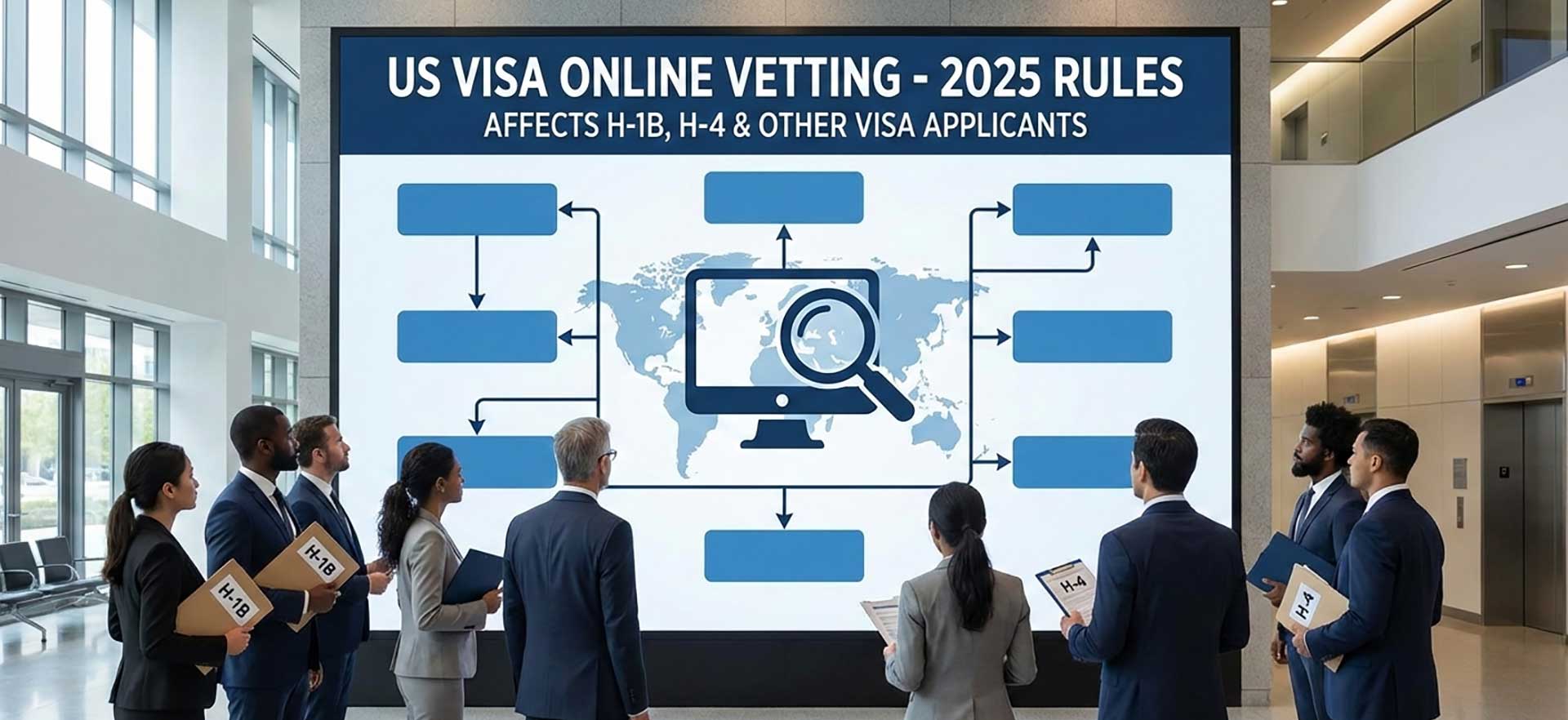
How New US Online Vetting Rules for 2025 Affect H-1B, H-4 & Other Visa Applicants
Learn about the updated US visa screening process in 2025, including mandatory online presence reviews, LinkedIn and social media screening for H-1B and H-4 applicants, and how to prepare your digital profiles to improve approval chances.
Introduction
In late 2025, the United States implemented significant changes to its visa screening procedures. These changes expand digital background checks to include social media activity, professional profiles, and online footprints especially for H-1B temporary work visas and H-4 dependent visas. Previously applied primarily to student and exchange visas, this new approach reflects a broader emphasis on digital vetting for all categories of applicants.
Effective December 15, 2025, U.S. consulates worldwide have begun requiring visa applicants, including those in the H-1B and H-4 categories, to make certain parts of their online presence accessible for review. This development has led to changes in appointment scheduling, interview procedures, and digital profile preparation for millions of applicants.
What Is the Expanded Online Presence Review?
The U.S. Department of State has broadened its online presence screening to go beyond traditional document checks. Under the new vetting process:
- Consular officers will examine social media profiles, including publicly accessible information on platforms such as Facebook, Instagram, X (formerly Twitter), LinkedIn, YouTube, TikTok, and other publicly available social accounts.
- Applicants in the H-1B and H-4 categories who previously were not universally subject to this review must now also participate in this screening, along with F (student), M (vocational), and J (exchange) visa holders.
- Resumes, professional profiles, particularly LinkedIn, will be reviewed in conjunction with employment history, job titles, and responsibilities to verify consistency with visa applications.
The intention behind this expanded procedure is to use all available public information to understand the applicant’s background and confirm eligibility under U.S. immigration law.
Why LinkedIn, Resumes, and Social Media Matter Now
According to recent reporting, the enhanced vetting process specifically instructs consular officers to analyze professional and online information of H-1B applicants and their dependents. Officers may review resumes and LinkedIn profiles to verify:
- Employment history and job roles
- Employment dates
- Industry involvement or responsibilities
- Consistency between online profiles and visa application details
- Any public content that might be relevant to eligibility assessments
This means that your online and professional footprint now functions almost like another supporting document in your visa application.
How the New Screening Affects Applicants in Practice
Appointment Delays and Rescheduling
Many H-1B and H-4 visa interviews scheduled for late 2025 were postponed as consulates adapted to the expanded vetting process, with some moved to early 2026 to allow additional time for online presence reviews.
Public Access to Social Media Required
Visa applicants are now expected to set their social media privacy settings to the public during the application and vetting process, allowing officers to access posts, connections, and online activity.
Key Steps Applicants Should Take Before Applying
1. Verify Your LinkedIn and Resume Details
Ensure your employment information matches your DS-160 and petition documents.
2. Adjust Social Media Privacy Settings
Set platforms like LinkedIn, Facebook, Instagram, X, YouTube, TikTok to public during vetting.
3. Review and Clean Up Public Content
Ensure posts align with your professional and personal background.
4. Prepare for Longer Processing Times
Expect delays due to expanded vetting.
Why This Change Is Happening
The expanded vetting is part of updated U.S. immigration security policy. Social media and online presence now play a major role in verifying eligibility and reducing risks.
Mandatory DS-160 Social Media Requirements (Official Guide)
DS-160 SOCIAL MEDIA SECTION – OFFICIAL GUIDE
For all U.S. Visa Applicants
(F, M, J, B1/B2, H1B, H4, L1, O, P, R, etc.)
STEP 1: Understand the Rule
The U.S. Government requires you to list every social media platform and username used in the last 5 years, including:
- Active accounts
- Old or deleted accounts
- Inactive accounts
- Any account linked to your real identity
If you used it, you must declare it.
STEP 2: Official DS-160 Dropdown List
These 20 platforms appear in the actual DS-160 form:
OFFICIAL DS-160 SOCIAL MEDIA PROVIDER LIST
Ask.fm | Douban | Facebook | Flickr | Google Plus | Instagram | LinkedIn | Myspace | Pinterest | Qzone / QQ | Reddit | Sina Weibo | Tencent Weibo | Tumblr | Twitter / X | Twoo | Vine | VKontakte (VK) | Youku | YouTube | None
Select the platform and enter your username.
STEP 3: Platforms NOT in DS-160 but STILL REQUIRED
Even if NOT listed, they must be declared under “Other Social Media”:
TikTok | Snapchat | WhatsApp (if username or business profile used) | Telegram | Discord | Signal | Threads | Clubhouse | Koo | ShareChat | Moj | Josh | Any gaming platform with a public username | Any blog or website you post on publicly
Example (Other Social Media):
Platform: TikTok
Username: @dipeshtours
STEP 4: How to Write Usernames Correctly
Examples:
- Facebook → Dipesh.Tours
- Instagram → dipeshtours
- YouTube → dipeshtours
- X/Twitter → dipeshtours
- TikTok (Other) → dipeshtours
Use your actual public identifier.
STEP 5: What You Must NOT Do
- Do NOT hide accounts.
- Do NOT select “None” if accounts exist.
- Do NOT delete accounts suddenly.
- Do NOT change usernames before interview.
- Do NOT lie — U.S. systems detect online presence.
TEMPLATE FOR CLIENTS
Dear Applicant,
As part of your U.S. visa process, the U.S. Government requires you to provide all social media usernames used in the last 5 years.
Platforms officially listed on the DS-160 form include Facebook, Instagram, YouTube, X (Twitter), LinkedIn, Pinterest, Reddit, Tumblr, and more.
Platforms NOT listed but still required include TikTok, Snapchat, WhatsApp (business), Telegram, Discord, Signal, Threads, ShareChat, Moj, Josh, Clubhouse, and any other platform where you have a public profile.
Please provide the username or handle for every social media account used in the past 5 years.
Warm regards.
Conclusion
The new 2025 U.S. online vetting rules and DS-160 social media requirements mark a major shift in visa processing.
Your digital identity is now part of your immigration identity.
By ensuring consistent, clean, and accurately presented online profiles including LinkedIn, resumes, and all social media you improve your chances of a smooth and successful visa approval.
Related Post
Top Reasons for US Visa Rejection in 2025 – Complete Guide to Avoid Refusal

Best Solo Trip Destinations for First-Time Travellers (2025)